Friday, January 28, 2011

Photo of the Day

We all have photographs that we wish we could have done a better job capturing them. Even though they are not technically great, we cherish them because they have a special meaning or significance to us. This is one of a series of photographs that fit this catagory for me.


Yellowstone wolves attacking a bull elk
In mid June of  2009, I was visiting Yellowstone National Park. As per my usual luck, the weather had been pretty gray and cloudy most of the precious few days I had to visit. Late one afternoon I was making my way toward the West gate when I saw something running across the vast meadow off to my right. Wildlife sightings in Yellowstone usually bring traffic to a standstill on the narrow two lane roads, and the scene that was unfolding cause a major traffic stoppage. Although they were extremely far away from the road, it was apparant that three wolves were in hot pursuit of a male elk.

I have watched countless televison specials, movies, and videos of scenes like this, but I had never witnessed one in person. There is no comparison. While watching and trying to photograph this I actually got goose bumps. The elk jumped into a small stream to help slow the wolves down and not allow them to attack him from the rear. The Black wolf who is running from a charge by the elk in this frame can clearly be observed wearing a tracking collar in other shots. He also appeared to be the dominant wolf and lead the numerous attacks on the bull elk.

Trying to photograph this with the equipment I had was a real challenge. I was shooting a Canon 50D, and the longest lens I had was a Canon 400mm f5.6 fixed focal length lens. A super sharp lens but at f5.6 not great in low light. With that lens on they were still to small in the viewfinder so I had to add a 1.4 extender to now give me 560mm of focal length. Sill not enough, but it was the best I could do. The issue was this canceled out the auto focus on the lens and pushed it to an f8 minimum apeture with no image stabilization. Afraid I would miss the action if I tried to dig out my tripod or monopod, I just braced against my vehicle and fired away. Trying to manually focus and track moving creatures at over 500mm is not easy.   At ISO 400 I was able to get 1/1000 second on some frames at f8. I ended  up with about 20 usable frames from this amazing event. I really wished I had a better body and much bigger lens, but you just have to do the best you can with the equipment you have. None of them are great, but I cherish them and this was the highlight of this trip to see something like this.

So now you want to know the rest of the story, right? Well the elk made several attempts to get out of the stream but was forced back in by the wolves. After standing long enough to catch his breath and gather up his resolve, The bull elk charged out of the stream and went on the attack and charged at the wolves. He really went after them hard and made them turn and run. They decided he was to much for them to handle and they allowed him to trot off. But no sooner did the elk leave and I saw the wolves zero in on a lone mother bison with a young calf off in the distance. I tried to track them to see what would happen but lost sight of them behind some trees. I knew without protection of a herd, they might be able to seperate the calf from it's mother. The cycle of life is often not very pretty to watch, but it is necessary.

Scott

Wednesday, January 19, 2011

Photo of the Day

This is one of my favorite shots that I have processed in the NIK HDR Software that I have been experimenting with. Taken this past October while I was at the Grand Canyon, the weather for that visit had been terrible. Gray days with heavy clouds that obscured the sun totally. The HDR software allowed me to pull out all the detail and color possible.

South Rim, Grand Canyon

Monday, January 17, 2011

Photo of the Day.

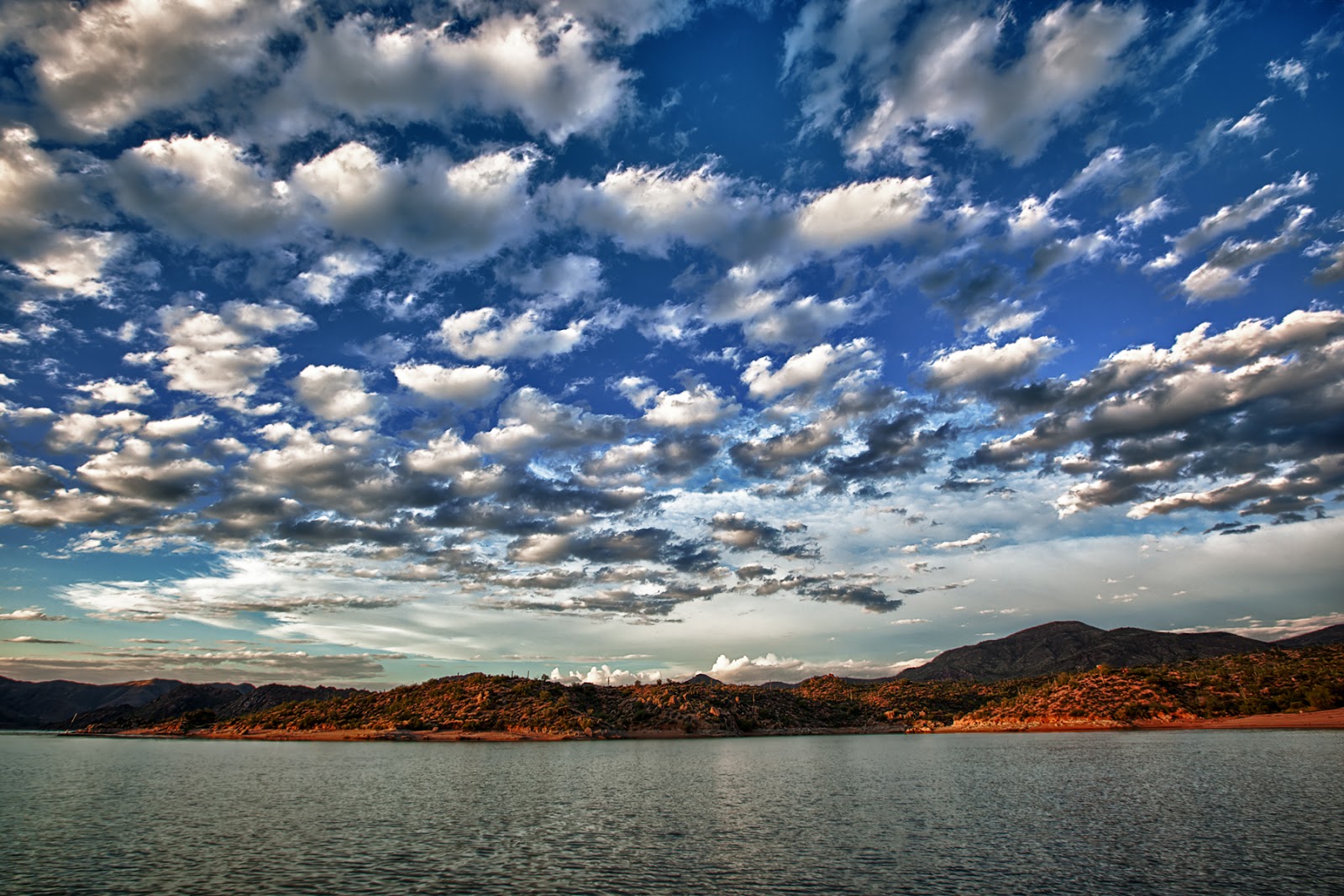
I am still working with the trial version of the NIK HDR Software. I am posting 2 photos today to show the power of HDR to create really compelling photographs. I was using a Canon 5D Mark II that I had on loan from Canon Professional Services. I used a Canon 16-35 f2.8L II lens on a tripod to take an automatic 3 shot bracketed exposure from my camera. The scene is the Bartlett Reservoir located in the Tonto National Forest near Cave Creek, Arizona. The setting for the auto bracketed exposure was for the camera to shoot a best guess exposure with the camera at 100 ISO, f16, and evaluative metering. Then the next exposure will be 2 stops under exposed, and the third exposure will be 2 stops over exposed.  Focus is set manually, and the camera is set to continous shooting mode. Use a cable shutter release and hold it down until the camera has taken all three exposures.


The first photo I am posting here is the best guess exposure straight out of the camera with no additional processing. 

Best guess single exposure JPEG file


HDR Image after processing

Even processing the best single exposed RAW file in CS5 will not give me the detail and tonal range I was able to do with the HDR software. As I have stated before, I like doing HDR from the natural look all the way to the craziest stuff imaginable. It just depends on what you want to do. It will take a lot of practice, failues, trial and error, and much more learning, but I am afraid I am a true HDR convert. Now when I look at a subject or scene to photograph, I will also consider the possibility of doing it as an HDR.  

Scott   

Friday, January 14, 2011

Photo of the Day

Grand Canyon, South Rim View

This is a 3 shot bracketed exposure that I took this past fall from the south rim of the Grand Canyon. The photo was processed in the newest version of the NIK HDR Software. It had been a very cloudy grey day and the light was flat and colors were really muted. I have been experimenting and trying different HDR software programs to see what works best for me. Although Photoshop CS5 has improved their HDR software a lot since CS4, it still will not truly tone map and allow you the control that other programs do. The goal on this shot was to keep the photo as natural looking as possible. I do like the really crazy results you can create with HDR software. For me it just depends on the subject matter and what I am trying to produce. For a stunning landscape such as the Grand Canyon I want the natural "what I saw" look. I have tried the Photomatix HDR software (version 3) which has been the best out  there for a long time and was considered by many as the gold standard for HDR. When I am done with my trial version of the NIK software I will try the newest Phtomatix version before I decide and purchase a software for my future HDR use.


Wednesday, January 12, 2011

Photo of the Day

Sand Key, Clearwater Beach Florida

It has been a brutal winter so far his year. As of today, 01-12-11, there is snow on the ground in 49 out of the 50 states in the United States. Currently only Florida is the only state that is snow free. So in honor of the Sunshine State, I am posting one of my many Florida Seascape photos. As I sit and look out at the grey cloudy skies and eye the thermometer at single digits without adding in a wind chill factor, I am wishing I was back down in south Florida. I used to make fun of the "snowbirds" who would flee the winters and head to warmer climates for several months. Now as I am getting older I am trying to figure out how I can do the same thing!

Monday, January 10, 2011

Photo of the Day

South Rim View, Grand Canyon National Park
This is a bracketed 3 shot exposure and processed in the new NIK HDR Software. The weather that day was very cold, cloudy, and windy. The light was flat and colors were very muted to the normal eye. I think this turned out better than any single exposure that I could process in Photoshop CS5.

Wednesday, December 22, 2010

Monument Valley

This past fall I took a road trip out west and visited some amazingly beautiful places that were very inspiring. I spent a lot of time in central and northern Arizona visiting national forests, parks, and wilderness desert areas. Sedona was beautiful, and the Grand Canyon is one of the most amazing natural wonders on the planet. As I moved north into southern Utah, I had been longing to return to a place I had briefly visited on a family vacation a very long time ago. Monument Valley.

Hwy. 163 coming into Monument Valley from the North
If you have ever watched the movie Forrest Gump, the scene where he stops running across the country was shot in this exact spot in the photo above. Highway 163 running south from Mexican Hat UT. into Monument Valley. In my opinion, one of the most iconic scenes you will ever see while driving on a road trip.
Massive Sandstone Mesas and Buttes rise from the desert floor

This area is a place you may feel very familiar with, and yet you have never been there. This area was discovered by Hollywood director John Ford in the late 1930's and there have been parts of over 70 major movies filmed in the area, along with countless television commercials and videos . So in your subconscious you have been here many, many times. But I highly recommend that you visit it in person. Like the Grand Canyon, this place must be visited in person to truly appreciate the stark beauty of the landscape. I spent three days here and wished I had at least a week.

Massive Butte with a daylight moon
For a landscape photographer this area is a pure paradise. Monument Valley lies within the 16 million acre Navajo Indian Nation


Along HWY. 163 south of Monument Valley
There are only a few options for lodging in Monument Valley. I stayed at The View Hotel, owned and operated by the Navajo Indians. This is the only hotel located inside the tribal park, and I highly recommend staying there. A bit pricey, but the view from your balcony is just amazing.

View from my hotel room balcony of the Mittens and Merrick Butte
If you just do a Google search on Monument Valley, you will find many links with all kinds of information you would need to learn more and plan a trip. My goal is not to rehash all that information here, but to inspire you to really consider visiting this place with my photography.

The North Window

I also highly recommend signing up with one of the local Navajo Indian guides for a tour. You can drive much of the area on a rough dirt road, but they have access to areas that are restricted unless you are with a guide. They provide great insight and information you would not get just driving it yourself.

The View Hotel, Monument Valley UT.

Three Sisters Rock Formation

The tough part of visiting Monument Valley as a photographer is trying to photograph as much as possible in the limited time you have. The desert light is extremely harsh within a couple hours of sunrise so starting very early is a must. Sunrises and sunsets there are spectacular if the weather cooperates.

Clouds add dramatic textures to the sky
A Monument Valley Sunset

I found a real sense of peace and rejuvenation in Monument Valley. While I was wandering alone in the early morning darkness or late afternoons looking for the perfect landscape photo opportunity, The desolate beauty and remoteness of this place are inspiring. I just wish I could have captured it better than I did on this trip. I know I will be back again.


Wednesday, December 15, 2010

Is That A Flamingo?

Roseate spoonbill -  Platalea ajaja

 Is that a Flamingo you are taking pictures of? That is a question I hear on a regular basis every time I visit the Ding Darling National Wildlife Refuge on Sanibel Island, Florida. What makes Ding Darling NWR such a great place is that it is a drive through wildlife park, and this allows many people to drive up and be very close to the many species of birds that are found in the refuge.  With Sanibel Island being a prime vacation spot, you have quite a few visitors to the refuge that might otherwise not be inclined to visit a wildlife refuge. With a polite smile and a suppressed laugh I say "No, those are Roseate Spoonbills". While many species of the birds have grown accustom to the human presence, Spoonbills are much more leery and tend to stay farther away. So I and many other photographers need to use some pretty big lenses on our cameras to bring them in close. This attracts attention and brings out the questions when they see the pink plumage. So for someone that is not familiar with birds, they assume the birds are Flamingos.
Spoonbill at Ding Darling NWR
 
Once you identify the birds as spoonbills, you can usually count on numerous followup questions. While I am at times amazed at some peoples total lack of knowledge, I do enjoy helping people out and giving them some useful information.  When you tell people that Flamingos are not really native to the U.S. they don't want to believe you. They just assume that since they have seen millions of the plastic ones in residential yards, they actually are native residents here.

Captive Caribbean Flamingos in a preserve
When you look at the birds plumage you can see how people can make the assumption that they are Flamingos. But that is where the similarity ends. One look at their overall body structure and beaks makes identification easy. In my recent trip Ding Darling NWR I spent five days there photographing birds. I was asked at least a dozen times. "Are those Flamingos?" While I was photographing birds one morning I was talking to one of the numerous volunteers who help assist people with information and show them birds through spotting scopes. I asked him how many times he is asked about the Flamingos. He laughed and said at least 10 times a day.


Caribbean Flamingo

Roseate Spoonbill
Both Species are beautiful birds in there own uniques way. Many species of birds look very similar, and many times it takes an expert to make an identification. But in this case, even I know the difference between a Spoonbill and a Flamingo.


Wednesday, December 1, 2010

Scenes from the Grand Canyon

A cold and cloudy morning hike

Many people visit the Grand Canyon, and if you have never had the chance to visit, put it on your must do list. I had visited a very, very, long time ago as a youngster on a family vacation. As an adult I had always wanted to go back, but it just never seemed to work out. I had flown over it many times on trips out west and watched countless programs on television. It does not matter how many films, television programs, or amazing photographs you see of the Grand Canyon, they do not begin to convey the size and beauty of one of the greatest natural wonders of the world. You must see it in person to truly be awed.
Sunrise on the South Rim
As a photographer I was hoping for Mother Nature to give me some ideal weather condition to try and create some amazing photographs. But one of the few things you cannot control as a photographer is the weather. I struggled with some very cloudy and overcast skies much of my short three day visit. If I am anything, I am persistent. I was out shooting as long as there was light, and I took every advantage when there was some breaks in the clouds that allowed some good light to come through.
A Mix of Sun and Clouds Create Amazing Patterns
I spent all three days on the South Rim area and plan to hit the North Rim on my next visit. One could easily spend at least a few weeks here just hiking all the trails and being rejuvenated by the beauty and peacefulness you find here.

Amazing South Rim View


Building Clouds In The Late Afternoon

Heavy Clouds Obscure The Setting Sun

I will not give you any facts or information on the Grand Canyon. There is more than enough of that available from  hundreds of sources. My goal is to inspire you to go if you have never been, or make you want to go visit again.
 I still have a few hundred photos to sort through and process from the trip. I will be back, but I can now say I have been and experienced and fully appreciate what a truly wondrous place the Grand Canyon is.


Scott

Friday, November 26, 2010

Scenes from Sedona

On my most recent road trip to Arizona several weeks ago I went to Sedona to visit this exceptionally beautiful region. My regret is that I was only spent one day there. I had to drive about 90 miles north to get there and, and left before I really had a chance to explore and see it well. On my next trip to Arizona I plan on spending several days in Sedona to better explore and photograph the area.

Bell Rock,  Sedona AZ
As a photographer you want to be there at first light to get that beautiful soft light of that golden hour. Unfortunately with having to drive a great distance from my base, and traveling with non-photographers who would not want to get up at 4:30 am to drive there before sunrise, I arrived like most other tourists in the late morning when it was already crowded. 
Red Sandstone Rock Formation, Sedona, AZ
So I had to crawl through the bumper to bumper traffic to get around the area and see the main attractions and sights. During the time I was there the light was extremely bright, but you just have to deal with it and try and do the best you can with the very limited time you have. 
Rock Formations and Clouds, Sedona, AZ.
I love Black and White photography and have started converting some of the shots I took on this trip to B&W. Luckily the light was very bright but not to harsh and I had great clouds to add texture and depth to the beautiful blue skies. Many of those shots look better after being converted.

A View of the Valley Below
 If you are planning a trip to Arizona, I highly recommend spending at least a couple days here. The beauty of the landscape is just amazing. I will be back to more throughly explore and photograph the landscape in Sedona.

SCOTT


Sunday, November 21, 2010

Photographs From The Road


Hwy. 88 in the Superstition Mountains
 Recently I went on an 18 day road trip to Arizona and Utah. I had intended to post photos and information on my blog every few days as the trip progressed. I drove about 5000 miles in that time through 8 different  states. I was trying to squeeze what should have been a 3 month trip into that small window of time that I actually had. The good thing about a trip like this is you get to see a lot of scenery and visit many interesting places. The downside is that you do not have the time at any place to really stay and explore it totally. When I visit somewhere new I would much prefer to have more time to throughly explore and learn all that I can and photograph the location.


A bridge on Hwy. 88 climbing into the mountains


With all the places I wanted to visit on this trip, and so little time to do it, I did a lot of driving and quick visits to many locations. I took more photos on this trip that I care to reveal because many people would laugh and tell me I am crazy unless they were a serious photographer. I did some wildlife photography, but the vast majority of my photos on this trip were shots of the amazing landscapes. Although I shoot digital, and always in color, I love to convert manyof the southwest landscape scenes to Black and White.


Abandon Building Outside Roswell New Mexico

I was driving into Roswell New Mexico when I noticed this abandon building sitting alone in he middle of no where. There were no signs to indicate what it may have once been. I stopped and photographed it from several angles and bracketed some exposures for an attempt to do an HDR image. My problem was it was in the middle of the day and the sunlight was extremely bright with not a cloud in the sky. When I was looking at the images, I was not real happy with them. Plain and boring to me. Then I tried the conversion to B&W but was not happy with the plain sky. In a stroke of creativity I darkened the blue and cyan channels to create this totally black looking sky. With some further tweaking in the various color channels, it now appears that it was taken at night with a bright moon light. A good Photoshop save of an otherwise drab photograph. No idea what happened here, but I think the aliens from nearby Area 51 may have been involved.

Scott                                                                                           


Monday, October 11, 2010

The Bald Eagle

Although I am not looking forward to winter due to the cold, damp, and generally miserable gray skies of the midwestern weather patterns, it does bring the return of he Bald Eagles. Since I am geographically located very close to the Mississippi River and the lock and dam in Alton, IL., this creates a a great place to view and photograph a good concentration of eagles. As the eagles move down south to avoid the frozen north, they congregate along the river. Eagles main diet are fish, and they need open water to feed.


Bad Eagle Taking flight
Although you can find eagles all up and down the Mississippi River during the winter months, the greatest concentrations of them can be found at the numerous lock and dams along the river. The reason for this is that even when the weather is extremely cold and the river freezes over, the waters around the locks are still open. As the water comes through the dam, many fish are stunned or killed. The eagles feed on these easy pickings. This makes for superb bird watching and photographing these beautiful birds.

After catching a fish it was attacked by another eagle and forced to drop it

Eagles are very opportunistic and will routinely attack other eagles to steal the fish it has just caught. The photo above was captured at the Alton Lock and Dam, and the background is the lock wall where barges pass through. They will also catch and eat other birds or small animals out of necessity to eat.  

Taking a catch back to the perch to feed
In order to really get great photographs of these birds you are going to need a lot of focal length to reach them and fill the frame. Generally you will need about 400mm of focal length or greater to reach them as they fly out over the river. Occasionally I have gotten good shots with my 70-200mm and 1.4 extender attached when they fly close to where I am standing. Many times they will sit in the trees along the river which allows people to stop and get some closer views. 

Watching the river from the top of a tall tree

This eagle in the photograph above was sitting very high up in the tree watching the river. The angle shooting up from the ground was to steep in for a long telephoto lens. The tree was right next to the Clark Bridge in Alton, so I climbed the embankment and got up on the bridge ramp to get to nearly eye level to take this shot. After dodging some traffic, I was able to get some some great shots of this eagle. Although there was some good distance between us I was using a Canon 800mm lens that I had gotten on loan from Canon Professional Services to try out. That big lens made this an almost full frame capture.

Here is a great link if you want to learn more information about the Bald Eagle.


  http://www.baldeagleinfo.com/


Friday, October 8, 2010

Central Illinois Landscapes

 In a recent post I comment on the challenges of doing landscape photography in my area of the world. While I would love to do more of the iconic scenery that can be found across this great county, I can find excellent scenes to photograph close to home. These are photographs I created within a close radius of my home.


Clark Bridge, Alton IL. at sunset


Goshen Rd. barn and building storm clouds


Goshen Rd. Sunrise

The barn in this sunrise scene is the same barn in the B&W above it. Amazing how the same scene can be photographed from different perspectives and angles to create many unique photos of just this one subject.


Fading Away Rt. 16 and Rt. 127, Hillsboro IL.

With Illinois being such a large agricultural state, the mostly pancake flat central part of the state has many of these old barns that are no longer being used because modern farming has made them obsolete.
They are usually left to rot away until they collapse and get burned or hauled away. I love to photograph them. 


Monday, October 4, 2010

ROAD TRIP

Probably my two favorite words to hear are road trip. You will never have to ask me twice, nor will I think about it for more than a nano second. I love to travel and going by vehicle is by far the most enjoyable for me. I am heading out soon for a 18 day driving trip to Arizona and back. I would love to have unlimited time to do a very leisurely trip that allowed me the luxury to stop, explore, and photograph everything of interest to me, but then I would be gone forever. So I will be trying to cram what I would love to be a three month trip into a much shorter time frame.

I80 near Cody, WY.

I love to get off the Interstate and travel at a much slower pace to see the all the unique scenery and attractions that this country has to offer. This current trip will have me going to Arizona where I have a condo rented for a week in Cave Creek. Cave Creek is about 45 miles north of Phoenix.  From that base I will be able to drive to many of the places I want to photograph.


Old Rt. 66, Litchfield, IL.
There are a a few stretches along the route I am taking where you
can find much of the old historic Rt. 66 left. I am hoping to be able to have time to stop and photograph some of the iconic scenes and buildings that are such a big part of this piece of American history.

I am also planning a two day stop on the South rim of the Grand Canyon. Luckily I was able to find lodging at one of the national park lodges located there that is managed by Xanterra. From there I am headed for a two night stay at Monument Valley. The View Hotel is a fairly new hotel, and is the only located in Monument Valley. I am hoping to be able to get some great landscape photos on this trip. 


Badlands National Park, South Dakota


Planning the trip is both enjoyable and agonizing. While I pour over the maps and books to research where I want to go and what I want to see, I must make tough decisions as to what gets cut out of the trip due to time constraints. I still have to finish the route back from Arizona, but I am fairly certain I will head up through Colorado. Sadly I will not have much time left to spend exploring that amazing region. I will be heading out on Oct. 14th and back on the 31st. I am hoping to do some posts from the road if I can.