
Pelicans are large water birds with a large pouch, belonging to the bird family Pelecanidae.

Brown
Brown Pelican, Ft. Myers, FL. (The classic pelican photograph)
Along with the darters, cormorants, gannets, boobies, frigatebirds, and tropicbirds, pelicans make up the order Pelecaniformes. Modern pelicans, of which there are eight species, are found on all continents except Antarctica. They primarily inhabit warm regions, though breeding ranges reach 45° south,Australian Pelicans, and 60° North, American White Pelicans, in western Canada. Birds of inland and coastal waters, they are absent from polar regions, the deep ocean, oceanic islands, and inland South America.

American White Pelicans, Two Rivers NWR, Alton IL.
Of the eight species of pelicans, two can be found in the United States. The Brown Pelican, and the Ameican White Pelican.The diet of a Pelican usually consists of fish, but they also eat amphibians, crustaceans and on some occasions, smaller birds.They often catch fish by expanding the throat pouch. Then they must drain the pouch above the surface before they can swallow. This operation takes up to a minute, during which time other seabirds are particularly likely to steal the fish. Pelicans in their turn sometimes pirate prey from other seabirds.
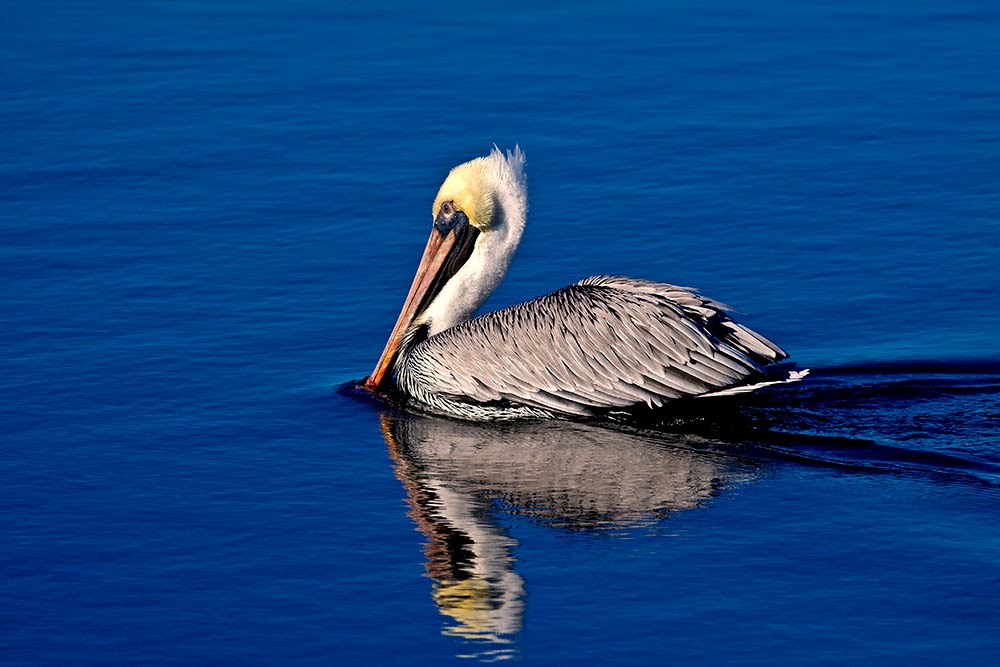
Brown Pelican swimming at Ding Darling NWR, Sanibel FL.
The white pelicans often fish in groups. They will form a line to chase schools of small fish into shallow water, and then scoop them up. Large fish are caught with the bill-tip, then tossed up in the air to be caught and slid into the gullet head first. The Brown Pelican of North America usually plunge-dives for its prey.
American White Pelicans sun and preen, Ding Darling NWR, Sanibel, FL.
Pelicans do not store fish in their pouch, but simply use it to catch them and then tip it back to drain out water and swallow the fish immediately. The American white pelican can hold some 3 gallons (11 1/2 liters) of water in its bill. Young pelicans feed by sticking their bills into their parents' throats to retrieve food.

Brown Pelican Portrait, Estero Lagoon, Ft. Myers Beach, FL.
Pelicans swim well with their short, strong legs and their feet with all four toes webbed (as in all birds placed in the order Pelecaniformes). The tail is short and square, with 20 to 24 feathers. The wings are long and have the unusually large number of 30 to 35 secondary flight feathers. A layer of special fibers deep in the breast muscles can hold the wings rigidly horizontal for gliding and soaring. Thus they can exploit thermals to commute over 150 km (100 miles) to feeding areas.

American White Pelican in flight, Twin Rivers NWR, Alton IL.

Watching the sunrise, Ding Darling NWR, Sanibel FL.
Pelicans are really fun to watch as they feed and interact with other birds. When you first start into bird photography, they are a great species to start with. They tolerate humans very well, and since thery are very large birds, they fill up your view finder with a medium length telephoto lens in many cases. Most of my pelican shots are donw with a 70-200mm zoom and a 1.4 extender. Their flight patterns are fairly slow and steady so they are very easy to track in flight.


